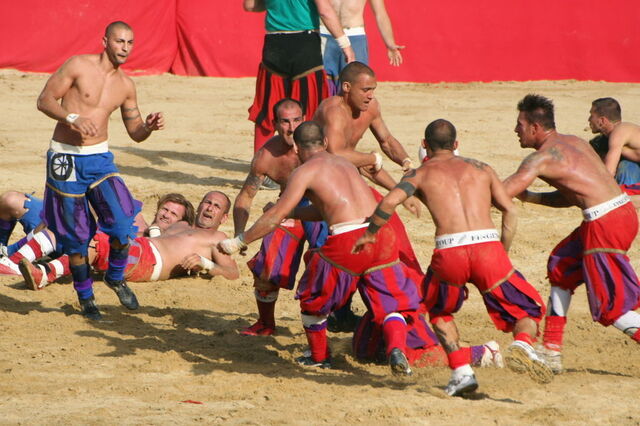
A precursor to soccer called il calcio storico fiorentino is played annually during the third week of June in Florence. Quite unlike the game that we are all familiar with, calcio storico is a brutal, violent sport intimately interconnected with the city's history, rivalries and codes of honour. It is more like a blend of soccer with rugby and boxing.
Not for the faint of heart, players often refuse to invite their families to games as they find it too difficult to watch. For the sports enthusiast however, it offers a unique experience. Why not book into a luxury villa nearby and come experience it for yourself?
Not for the faint of heart, players often refuse to invite their families to games as they find it too difficult to watch. For the sports enthusiast however, it offers a unique experience. Why not book into a luxury villa nearby and come experience it for yourself?
In the Renaissance, the game was actually reserved for aristocrats and even popes are known to have played! In the 20th century it was revived and recognised as an official Italian sport.
Three games take place each year between teams from each of the four quarters of Florence; two opening games and a deciding match on June 24th. The teams are Santa Croce (the Blues), Santa Maria Novella (Reds), Santo Spirito (Whites) and San Giovanni (Greens). Players are volunteers and the only compensation is honour and the banquet given to the winning team. Teams are comprised of 27 players – 4 goalies, 3 fullbacks, 5 halfbacks and 15 forwards – with no substitutions.
There is also a captain for each team who guides the team strategically, keeps them motivated and under control. A referee, six linesmen and a judge commissioner maintain some sense of order in the game.
Three games take place each year between teams from each of the four quarters of Florence; two opening games and a deciding match on June 24th. The teams are Santa Croce (the Blues), Santa Maria Novella (Reds), Santo Spirito (Whites) and San Giovanni (Greens). Players are volunteers and the only compensation is honour and the banquet given to the winning team. Teams are comprised of 27 players – 4 goalies, 3 fullbacks, 5 halfbacks and 15 forwards – with no substitutions.
There is also a captain for each team who guides the team strategically, keeps them motivated and under control. A referee, six linesmen and a judge commissioner maintain some sense of order in the game.
There are few rules and a high level of violence is allowed. Sucker punches and kicks to the head are not allowed and will result in immediate removal from the arena but head-butting, punching, elbowing and choking are permitted. Supposedly swords were once allowed in the game!
Games last 50 minutes in an arena laid with sand and a narrow slit running the width of the pitch at each end which serves as a goal. Players can use hands or feet and if they get the ball in the other team's goal they get a point, or a caccia. The other team gets half a caccia if they miss. The team with the most points at the end of the game wins.
The atmosphere at the games is electric and testosterone-driven. Crowds of thousands attend each year and fans are known to dangle over the railings in excitement, trying to get closer to the game.
If you are in Florence at the end of June, this experience – so different to much of what the city has to offer – is not to be missed!
Games last 50 minutes in an arena laid with sand and a narrow slit running the width of the pitch at each end which serves as a goal. Players can use hands or feet and if they get the ball in the other team's goal they get a point, or a caccia. The other team gets half a caccia if they miss. The team with the most points at the end of the game wins.
The atmosphere at the games is electric and testosterone-driven. Crowds of thousands attend each year and fans are known to dangle over the railings in excitement, trying to get closer to the game.
If you are in Florence at the end of June, this experience – so different to much of what the city has to offer – is not to be missed!
Photo credits
picture 1: Lennaz / CC BY-SA 3.0;
picture 2: View of Florence
picture 1: Lennaz / CC BY-SA 3.0;
picture 2: View of Florence