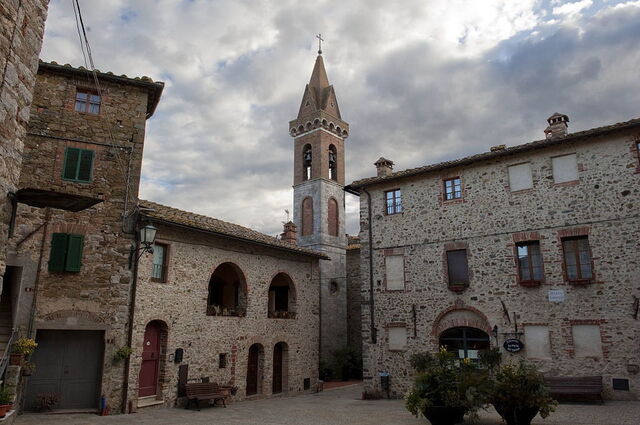
San Gusmè is a picturesque fortified medieval village on a small hill which is surrounded by a long, circular wall in the region of Chianti in Tuscany. A charming little town full of pretty buildings and churches, it offers great views across the rolling hills and plains of the typical Tuscan landscape which surrounds. Siena and the profile of Torre del Mangia and the Duomo are even visible in the distance. Unlike other towns in the area, San Gusmè is devoid of major attractions, museums or shops, its charm is in the tranquillity that it offers. Here it seems as though time stopped a long time ago and continues to do so, offering a respite from the craziness of modern life.
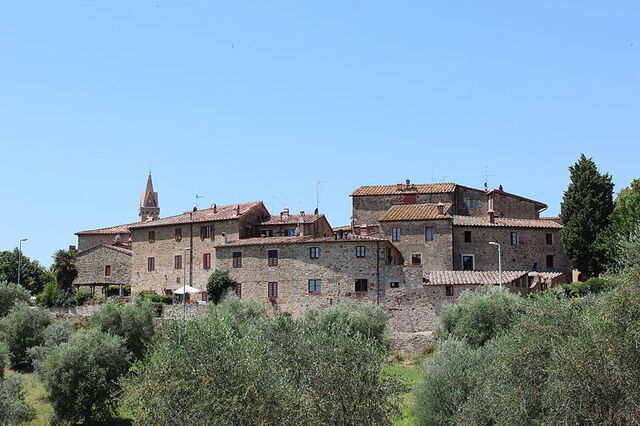
Find a villa with pool in Chianti and spend a relaxing holiday getting away from it all. Be sure to stop by San Gusme for a day, take in the scenery, fresh air and calm.
The village was established in the late 14th century and some of the original structures still exist to this day, including some parts of the defensive walls, though pieces have since been incorporated into nearby buildings and the gateways into the town. The entrance from Siena is marked with the Sienese coat of arms hewn from local stone, the "Balzana" which speaks to the long history of San Gusmè's affiliation with the Republic of Siena.
The village was established in the late 14th century and some of the original structures still exist to this day, including some parts of the defensive walls, though pieces have since been incorporated into nearby buildings and the gateways into the town. The entrance from Siena is marked with the Sienese coat of arms hewn from local stone, the "Balzana" which speaks to the long history of San Gusmè's affiliation with the Republic of Siena.
Of particular note and architectural and historic merit are the Church of Saint Cosmas and Damian, the Early Christian martyrs and patrons of the town, and the Church of Santissima Annunziata with its distinctive campanile.
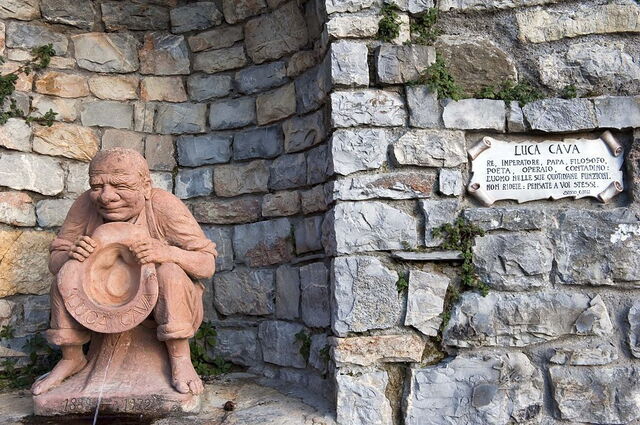
Next to the main entrance into San Gusmè is a rather unusual terracotta statue which depicts a man squatting and relieving himself with an inscription which reads, “King, emperor, pope, philosopher, farmer and worker: a man doing his daily functions. Do not laugh, think only of yourself."
This bizarre work of art is linked to a legend in the town going back to the late 19th century. The story goes that an innkeeper in the town became tired of cleaning the waste of his rather messy customers and built an outhouse, labelling it the "Public Toilet". As most of his customers were illiterate, however, the sign meant nothing to them and they didn't use the outhouse. The innkeeper then had the statue made to explicitly show what the outhouse was to be used for. Finally understanding, they began to use it. The statue came to be known as "Luca Cava", an Italian play on words which are very much lost in translation.
Today, the statue is celebrated by a festival during the first two weekends of September. The Luca Festival entails live music, delicious food, hand-made goods and wine tastings. The full schedule can be found online and it's something anyone visiting Chianti and looking for a genuine experience of Tuscan life and traditions should make time for.
Next to the main entrance into San Gusmè is a rather unusual terracotta statue which depicts a man squatting and relieving himself with an inscription which reads, “King, emperor, pope, philosopher, farmer and worker: a man doing his daily functions. Do not laugh, think only of yourself."
This bizarre work of art is linked to a legend in the town going back to the late 19th century. The story goes that an innkeeper in the town became tired of cleaning the waste of his rather messy customers and built an outhouse, labelling it the "Public Toilet". As most of his customers were illiterate, however, the sign meant nothing to them and they didn't use the outhouse. The innkeeper then had the statue made to explicitly show what the outhouse was to be used for. Finally understanding, they began to use it. The statue came to be known as "Luca Cava", an Italian play on words which are very much lost in translation.
Today, the statue is celebrated by a festival during the first two weekends of September. The Luca Festival entails live music, delicious food, hand-made goods and wine tastings. The full schedule can be found online and it's something anyone visiting Chianti and looking for a genuine experience of Tuscan life and traditions should make time for.
Photo credits
picture 1: Vignaccia76 / CC BY 3.0;
picture 2: LigaDue / CC BY-SA 4.0;
picture 3: Vignaccia76 / CC BY 3.0
picture 1: Vignaccia76 / CC BY 3.0;
picture 2: LigaDue / CC BY-SA 4.0;
picture 3: Vignaccia76 / CC BY 3.0