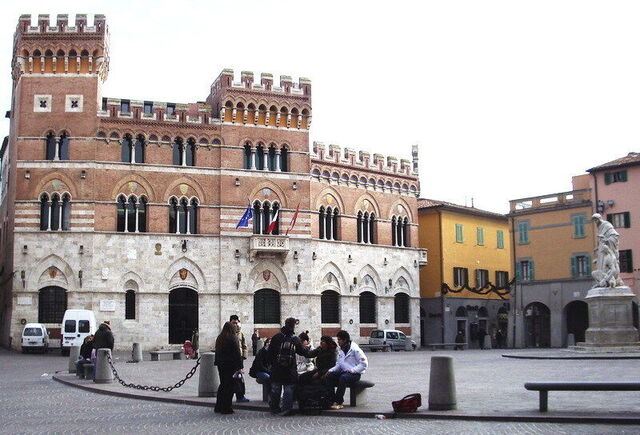
In the Tuscan city of Grosseto there is a charming building in the historic quarter which immediately stands out from the surrounding structures. Dressed in stone on the ground floor with a red brick face to the second and third storeys and polychromatic accents, it is a beautifully decorative building. This is the Palazzo Aldobrandeschi which dates back to the Middle Ages and is built in the Gothic style. However, this façade might trick you, it is, in fact, Gothic Revival as the palace was rebuilt in the 19th century due to the deterioration of the building over the decades. Still an exceptionally lovely and fascinating building, anyone visiting Grosseto should make time to pass by and admire it.
Just find a holiday rental in Grosseto and spend time wandering its traffic-free and peaceful historic quarter.
Just find a holiday rental in Grosseto and spend time wandering its traffic-free and peaceful historic quarter.
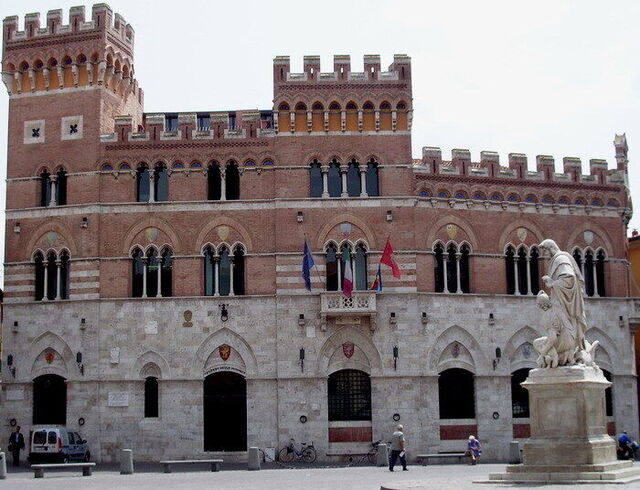
The original construction dating back to the Mediaeval period was associated with the complex of the nearby Aldobrandeschi fortress and church dedicated to San Giorgio. Over time, both were abandoned and subsequently demolished. Meanwhile, the Palazzo became the town residence of the Aldobrandeschi family who lived there for generations in luxury. The building, however, later fell into decline. In the nineteenth century, it was decided that the palace should be knocked down and reconstructed, incorporating some of the pre-existing structure.
Lorenzo Porciatti was the architect in charge of the project and it was officially inaugurated in 1903. He chose to express the new structure in a Gothic Revival style which is clearly inspired by the style of the Gothic public buildings of Siena.
Lorenzo Porciatti was the architect in charge of the project and it was officially inaugurated in 1903. He chose to express the new structure in a Gothic Revival style which is clearly inspired by the style of the Gothic public buildings of Siena.
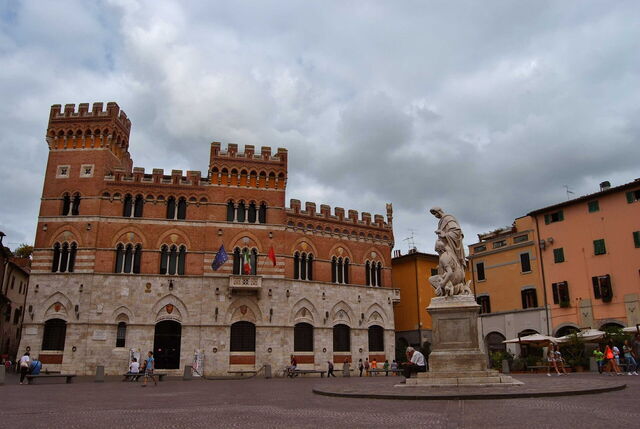
This is visible in the division of the volumes and explicit use of formal and decorative elements, inside and out, and in the materials chosen such as travertine and brick. The main façade is asymmetric and is divided into four visually distinct sections, two of which are topped by towers.
Decorative elements include coats of arms with heraldic symbols, a delicately carved balcony at the centre and at one end of the building, polychromatic panels of stone, columns carrying the pointed aches of the windows and a crenellated attic executed in brick and travertine in which the merlons are separated by simple loop-holes.
The building is now the headquarters of the Province of Grosseto and is, for this reason, well-preserved. It can be visited but some areas are off-bounds to the general public.
Decorative elements include coats of arms with heraldic symbols, a delicately carved balcony at the centre and at one end of the building, polychromatic panels of stone, columns carrying the pointed aches of the windows and a crenellated attic executed in brick and travertine in which the merlons are separated by simple loop-holes.
The building is now the headquarters of the Province of Grosseto and is, for this reason, well-preserved. It can be visited but some areas are off-bounds to the general public.
Photo credits
picture 1: Matteo Vinattieri / CC BY 2.5;
picture 2: Gabriele Delhey / CC BY-SA 3.0
picture 1: Matteo Vinattieri / CC BY 2.5;
picture 2: Gabriele Delhey / CC BY-SA 3.0