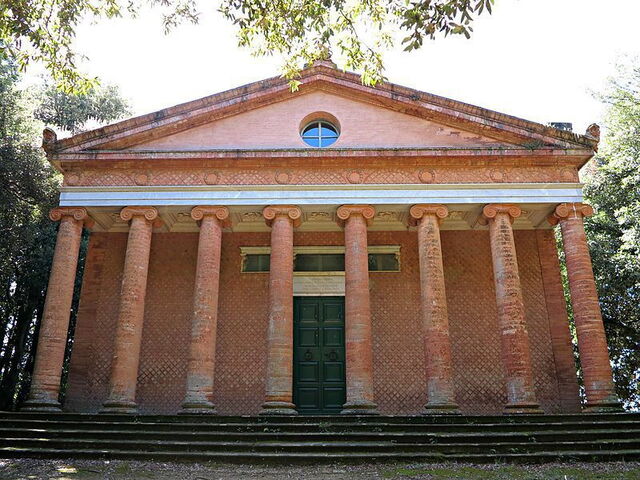
If you find yourself in the Pisa area and have an interest in architecture and history that goes beyond the Leaning Tower, why not find some time to visit the charming little Temple of Minerva Medica, or Tempio di Minerva Medica, (Goddess of Medicine and Wisdom) in Montefoscoli?
The structure was built according to the wishes of the internationally renowned Andrea Vaccà Berlinghieri, a physician at the University of Pisa, and dedicated to his father, Francesco, who also worked as a professor of surgery at the university. It was constructed on the picturesque site where Francesco had intended to build a villa.
The structure was built according to the wishes of the internationally renowned Andrea Vaccà Berlinghieri, a physician at the University of Pisa, and dedicated to his father, Francesco, who also worked as a professor of surgery at the university. It was constructed on the picturesque site where Francesco had intended to build a villa.

Both men were particularly gifted and helped lay the basis of modern medicine and, in doing so, raised the prestige of the university.
Work on the structure began in 1822 and the architect leading the project was Ridolfo Castinelli – who would later became an acclaimed civic architect. Set on a hillside, in Montefoscoli, and surrounded by a small wood of holm-oaks, the building is both picturesque in appearance and setting.
The temple is largely made of terracotta with the lintel of the pediment being comprised of white marble. It is built in the neoclassical style and, while it recalls the holy temples of ancient Greece and Rome, it was intended as a pleasure building for concerts and events. The façade is raised five steps and sees eight Ionic columns carry a triangular pediment with a circular window set inside it.
A semi-circular apse to the rear is attached to the rectangular front and recalls the older temple to the same goddess in Rome.
Despite the beauty of the temple and its surroundings, it also has slightly more frightening or spooky connections. Rumours have existed since Andrea’s day that under the temple of Minerva Medica there was a hidden room, used for his experiments on cadavers.
It has even been suggested that Mary Shelley visited Andrea’s laboratory under the temple and used it as a source for her story of Dr. Frankenstein and his monster.
Work on the structure began in 1822 and the architect leading the project was Ridolfo Castinelli – who would later became an acclaimed civic architect. Set on a hillside, in Montefoscoli, and surrounded by a small wood of holm-oaks, the building is both picturesque in appearance and setting.
The temple is largely made of terracotta with the lintel of the pediment being comprised of white marble. It is built in the neoclassical style and, while it recalls the holy temples of ancient Greece and Rome, it was intended as a pleasure building for concerts and events. The façade is raised five steps and sees eight Ionic columns carry a triangular pediment with a circular window set inside it.
A semi-circular apse to the rear is attached to the rectangular front and recalls the older temple to the same goddess in Rome.
Despite the beauty of the temple and its surroundings, it also has slightly more frightening or spooky connections. Rumours have existed since Andrea’s day that under the temple of Minerva Medica there was a hidden room, used for his experiments on cadavers.
It has even been suggested that Mary Shelley visited Andrea’s laboratory under the temple and used it as a source for her story of Dr. Frankenstein and his monster.
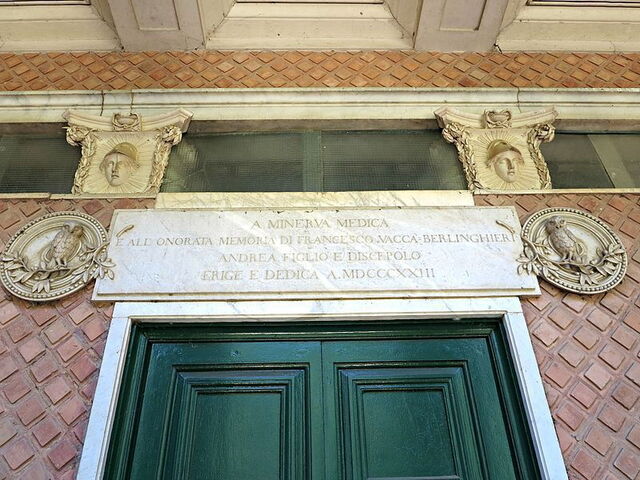
Explorations of the area around the temple have been subsequently undertaken recently and an empty room below the monument was discovered. While it is uncertain if this was his laboratory or if Mary’s visit really happened and although the temple was erected in 1822 and Frankenstein was published in 1818, Mary may yet have known about Andrea through a mutual acquaintance, Polidori. Frankenstein may have, indeed, been influenced by this site and its benefactor.
Today, you can visit the temple and even have events there upon reservation. Moonlit guided tours are offered every full-moon night by the “Ippolito Rossellini” cultural association, the next being on the 3rd of May.
Find yourself a holiday rental nearby Pisa and see the temple for yourself, as well as the many other things Pisa has to offer.
Today, you can visit the temple and even have events there upon reservation. Moonlit guided tours are offered every full-moon night by the “Ippolito Rossellini” cultural association, the next being on the 3rd of May.
Find yourself a holiday rental nearby Pisa and see the temple for yourself, as well as the many other things Pisa has to offer.
Photo credits
picture 1: Mongolo1984 / CC BY-SA 4.0;
picture 2: Biiodome;
picture 3: Mongolo1984 / CC BY-SA 4.0;
picture 1: Mongolo1984 / CC BY-SA 4.0;
picture 2: Biiodome;
picture 3: Mongolo1984 / CC BY-SA 4.0;