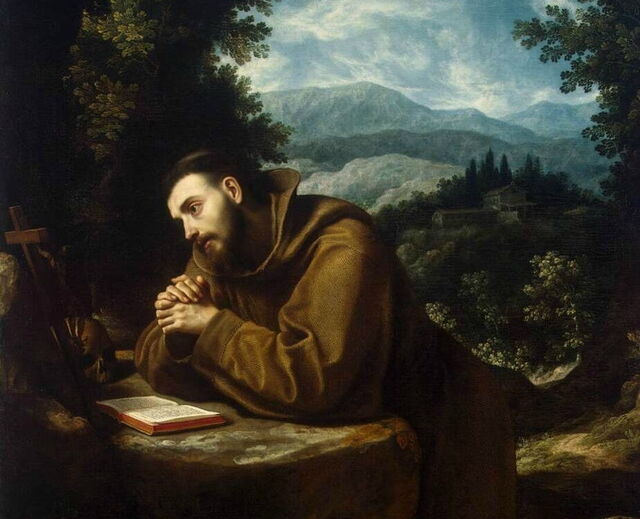
Saint Francis of Assisi is one of the most famous and well-known Italian saints. His story is perfectly formed to capture hearts and imaginations: the son of a rich mercantile family, he lived the life of a playboy and was a soldier but, after a being held in captivity as a prisoner of war for a year, he had a big change of heart and renounced his way of life entirely. He dedicated himself to a life of piety and charity and founded the Franciscan order, which is based on poverty and alms.
The order was officially recognised by Pope Innocent III in 1210 and the first convent was built in Cortona in 1211, where Saint Francis lived after receiving the stigmata. In 1245, after his death, a church dedicated to the saint was also built in the town. The church is stunning, filled with artworks by famous artists and, importantly, it is home to precious relics belonging to Francis himself. Just find a luxury villa in Cortona and uncover this gem of a building and the treasures within for yourself.
In 2007, research showed that some relics attributed to Saint Francis that were on display in the Church of Santa Croce in Florence could not have actually been his at all. The robes in question had been an important relic in the church for centuries but carbon dating pinpointed when they were made – more than eighty years after Francis had died. At the same time this news swept the world and was written about in newspapers all over the globe, there was confirmation that the robes also attributed to Francis in Cortona's Church of Saint Francis, dated to the period in which he was alive.
Though this does not prove that they did, in fact, belong to the saint, unlike the example in Florence, it proves that they could very well have. Pier Andrea Mandò, director of the Nuclear Physics Laboratory in Florence, where the work was done by the Laboratory of Nuclear Techniques for Cultural Heritage reported that, "The tunic and cushion from Cortona were found compatible with the period in which Saint Francis lived but the one from Florence wasn't."
The church is also home to distinguished artworks, including the Nativity of Raffaello Vanni, the Annunciation by Pietro da Cortona, St. Anthony of Padua, the Miracle of the Mule by Cigoli, and the Virgin in Glory among the Saints by Ciro Ferri and other relics such as a preserved fragment of the Holy Cross in a Byzantine reliquary. As such, there are a lot of interesting elements in this one church that make it a fascinating spot to visit in Tuscany.
In 2007, research showed that some relics attributed to Saint Francis that were on display in the Church of Santa Croce in Florence could not have actually been his at all. The robes in question had been an important relic in the church for centuries but carbon dating pinpointed when they were made – more than eighty years after Francis had died. At the same time this news swept the world and was written about in newspapers all over the globe, there was confirmation that the robes also attributed to Francis in Cortona's Church of Saint Francis, dated to the period in which he was alive.
Though this does not prove that they did, in fact, belong to the saint, unlike the example in Florence, it proves that they could very well have. Pier Andrea Mandò, director of the Nuclear Physics Laboratory in Florence, where the work was done by the Laboratory of Nuclear Techniques for Cultural Heritage reported that, "The tunic and cushion from Cortona were found compatible with the period in which Saint Francis lived but the one from Florence wasn't."
The church is also home to distinguished artworks, including the Nativity of Raffaello Vanni, the Annunciation by Pietro da Cortona, St. Anthony of Padua, the Miracle of the Mule by Cigoli, and the Virgin in Glory among the Saints by Ciro Ferri and other relics such as a preserved fragment of the Holy Cross in a Byzantine reliquary. As such, there are a lot of interesting elements in this one church that make it a fascinating spot to visit in Tuscany.