The walled city of Lucca is a stunning medieval gem that is full of incredible buildings, palaces, churches, pretty, little side streets and winding alleys, works of art, cultural hotspots, and historic beauties. If you find a vacation rental in the Province of Lucca or a holiday rental in Lucca, you will quickly realise that just wandering the streets of this charming city, so steeped in history, is a delight in its own right and utterly transports you back in time. However, it is not just the city that is rich in history and culture, the wider province around Lucca is full of little gems and fascinating surprises. One such gem is Massaciuccoli Romana, an archaeological complex that is home to a wide variety of ruins and remains from the time of the Romans including villas, baths, and more.
Located in the municipality of Massarosa, on the banks of Lake Massaciuccoli, the first indications of the Massaciuccoli Romana complex were first discovered back in 1756 though there wasn’t much public interest or involvement from the larger academic world until the 19th, and then the 20th, century. A Roman lead pipe inscription (a Latin inscription that is found on leaden Roman water pipes and which provides information on its manufacturer, owner, and often the reigning emperor) was found in 1770 and then the western sector of another group of structures was discovered in the 1930s, which included a balneum (a thermal plant built for private, rather than public, use) and mosaics, that were deemed to be part of a villa. In the 2000s the work at Massaciuccoli Romana was officially taken up and continued under the authority of the Municipality of Massarosa. The Municipality also opened the site as a tourist attraction and museum in this time period and continue to promote education, research, and excavation on the site to this day.
Located in the municipality of Massarosa, on the banks of Lake Massaciuccoli, the first indications of the Massaciuccoli Romana complex were first discovered back in 1756 though there wasn’t much public interest or involvement from the larger academic world until the 19th, and then the 20th, century. A Roman lead pipe inscription (a Latin inscription that is found on leaden Roman water pipes and which provides information on its manufacturer, owner, and often the reigning emperor) was found in 1770 and then the western sector of another group of structures was discovered in the 1930s, which included a balneum (a thermal plant built for private, rather than public, use) and mosaics, that were deemed to be part of a villa. In the 2000s the work at Massaciuccoli Romana was officially taken up and continued under the authority of the Municipality of Massarosa. The Municipality also opened the site as a tourist attraction and museum in this time period and continue to promote education, research, and excavation on the site to this day.
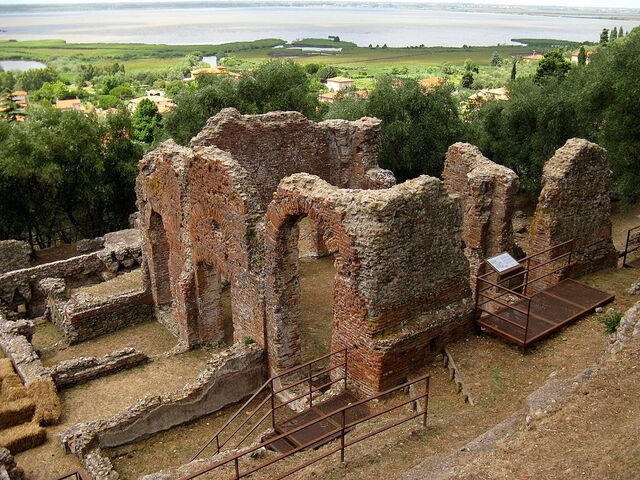
While there are older foundations on the site, the remains of the villa that is part of the complex belonged to the Venulei family, which was one of the most important families in the area that is now known as Pisa at the time and who are linked to the site through inscriptions found on parts of the buildings. The thermal complex was made up of several buildings which included rooms such as the frigidarium, tepidarium, calidarium, a large central hall, a massage room, vestibule, a latrine with a calida lavatio (hot bath tub) and praefurnium (oven in which hot air was produced at very high temperatures), a heating system, a courtyard garden, and various outbuildings such as barns, tool sheds, and more. Built at the beginning of the 1st century AD, there were then expansions and restorations between the 1st and 2nd centuries AD in order to accentuate the design and position of the monumental thermal complex to better highlight and make use of the amazing view over the lake and out across the coast and sea that it boasts. One can only imagine how it might have looked and what a bathing experience it would have offered contemporaneously when one is exploring the site and ruins that remain today. With the decline of the Venulei family at the end of the 2nd century AD the complex then sadly fell into ruin and was eventually abandoned until it was rediscovered centuries later.
The exhibition at the site today includes the ruins of the buildings that have been unearthed, including the building that is part of the Guglielmo Lera exhibition pavilion, which helps preserve mosaic remnants such as the floor mosaic of the frigidarium, a mosaic that is decorated with images of fantastical animal figures made from white and black tiles. As you explore the museum, you can learn more about daily life at the time in the area through a display of a selection of meaningful objects recovered on the site and about the archaeological excavations that are still currently underway. If you are interested in history and culture, this fascinating museum experience offers the opportunity to see a research and archaeological process that is alive and well and still under way. Just find a vacation rental in Lucca and plan a trip to this unique gem for yourself during your time in Tuscany.
The exhibition at the site today includes the ruins of the buildings that have been unearthed, including the building that is part of the Guglielmo Lera exhibition pavilion, which helps preserve mosaic remnants such as the floor mosaic of the frigidarium, a mosaic that is decorated with images of fantastical animal figures made from white and black tiles. As you explore the museum, you can learn more about daily life at the time in the area through a display of a selection of meaningful objects recovered on the site and about the archaeological excavations that are still currently underway. If you are interested in history and culture, this fascinating museum experience offers the opportunity to see a research and archaeological process that is alive and well and still under way. Just find a vacation rental in Lucca and plan a trip to this unique gem for yourself during your time in Tuscany.
Photo credit: Daniele napolitano / CC BY-SA 4.0