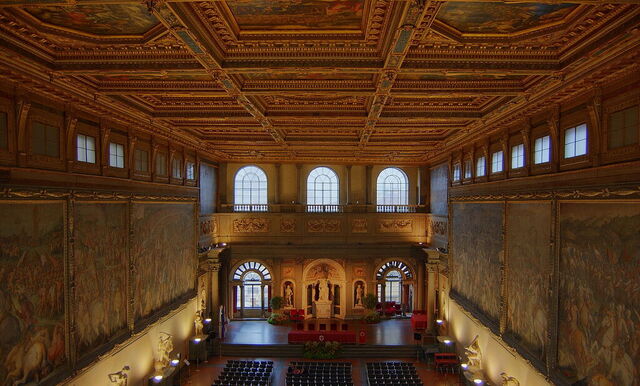
The Palazzo Vecchio is the beautiful and historic (and haunted) old town hall of Florence. Located right at the centre of the historic core of the city, it is one of many fascinating architectural gems in the area. However, if you have found a luxury villa in Florence and are interested in the history and heritage of the capital of Tuscany and the birthplace of the Renaissance then a visit to the Palazzo Vecchio to learn more about the origins of the city and how it developed up to the present day, who ruled over the lands, how the city has expanded and physically changed, important citizens throughout the ages from princes to artists to scientists, and more is a definite must. However, while you are exploring the building and being given context on the history of the city by your tour guide, be sure to pay attention to one room, in particular: the Salone dei Cinquecento, or Hall of the Five Hundred.
Located on the ground floor of the Palazzo Vecchio, the Salone dei Cinquecento, or Hall of the Five Hundred, was built in 1494 according to designs by Simone del Pollaiolo and commissioned by Girolamo Savonarola , the friar who encouraged the French to take the city and then became the spiritual leader of the newly established Republic of Florence after the ruling Medici family were exiled, until he was later excommunicated by the pope and eventually put to death. Initially designed to seat the 1000 citizens who were members of the Grand Council of the Republic and who gathered in two groupings of 500 (ergo the name), the Salone is a vast and imposing space that was then enlarged according to designs by Giorgio Vasari in order to house the court of the Grand Duke Cosimo I de' Medici once the Medici family had regained and solidified their political power in the city. Primarily used by the Duke for public ceremonies and as the visual centre piece of the celebration of his glory, it was once Cosimo began using the space that it was transformed into the incredible gem that can be seen today.
The Salone was intended to house two famous works by two sets of incredibly famous hands that were ultimately, and unfortunately, lost forever: the, “Battle of Cascina,” by Michelangelo and the, “Battle of Anghiari,” by Leonardo da Vinci. In the case of the, “Battle of Anghiari,” the fresco, like his iconic, “Last Supper,” fell victim to another one of da Vinci's experiments in fresco techniques that saw the paint dry too slowly and the artist bring in braziers stoked with hot coals to try and speed up the process. Unfortunately, this turned out to be a disastrous move and it actually lead to the work melting before the eyes of horrified gathered onlookers. According to legend, the original work still exists but is now encased behind a false wall that built overtop by Vasari in an effort to preserve it but attempts to try and uncover any evidence of there being any truth to this myth have been ineffective so far. Michelangelo, meanwhile, was called back to paint the Sistine Chapel before he could execute his fresco for the Salone and his preparatory sketches were then lost forever to a horde of frenzied young artists who came to study them and took chunks of the drawings away with them.
However, despite these not insignificant losses of what could have been some of the greatest artworks ever created, the Salone is not without artistic gems today. In fact, it is often seen as the jewellery box of, and highlight of any visit to, the Palazzo Vecchio and this is due, in large part, to the pieces that adorn the room today. There is a wonderful series of works in the Salone that were made between 1555 and 1572 by Vasari and his helpers and students, including Livio Agresti from Forlì, Giovanni Stradano, Tommaso di Battista del Verrocchio, Ridolfo del Ghirlandaio, and many others. Marking the culmination of mannerism, the room is home to a decorative scheme that reaches its height (literally and physically) on the coffered ceiling, which was raised a whopping seven meters by Cosimo and is decorated by 42 panels containing painted images of the glory of Florence and, in particular, the Medici. The central panel features Cosimo in apotheosis, around this are allegories of the districts of Florence and Tuscany in an act of submission to the Duke, and portraits of some of Vasari’s collaborators, and on the walls below are six different scenes from the War of Pisa (1496–1509) and the War of Siena (1553–1555). In addition to the wall and ceiling paintings, other artworks in the room include statues of members of the Medici family and of the two Medici popes, Leo X and Clement VII. Originally, rich 16th century tapestries completed the look but today they are only brought out on special occasions.
The whole effect of the vast space, beautiful architectural details inspired by Roman triumphal arches, and the rich array of painted and sculpted artworks in the room makes for a true feast for the senses, a real sense of the power and wealth that the Medici once held, and an absolute must-see if you have found a luxury villa in Florence and are spending time in this beautiful part of Tuscany.
Photo credit: Bradley Grzesiak / CC BY-SA 2.5