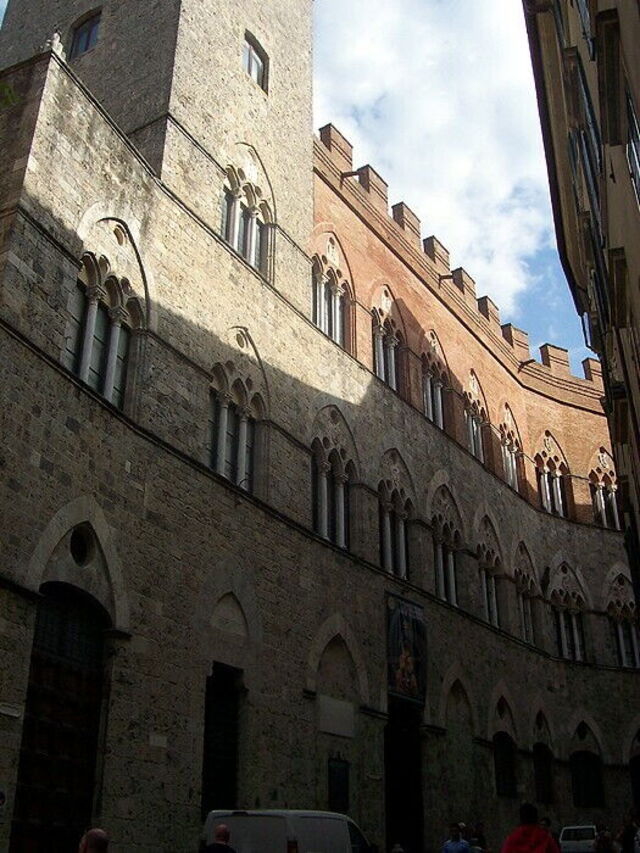
Tuscany is home to some exceptional old palaces that were once the elegant dwellings of the wealthy and the nobility of Italy in the past but are now open to the public to explore and are also home to some important and fascinating museums, venues, and other cultural institutions. One particularly great example of this is the Palazzo Chigi-Saracini, also known as the Vestri Palace, which is located in the stunning historic centre of the city of Siena. If you have found a luxury villa in Siena and are spending some time wandering and exploring this very charming Tuscan town, then stopping into the Palazzo Chigi-Saracini to have a look around this exceptional beauty and the, not one, but two incredible cultural gems housed within it is an absolute must.
Built in the 12th century, the Palazzo Chigi-Saracini is an architectural gem that was first erected by the aristocratic Marescotti family of Siena on top of the site of a castle that they owned in Siena. So central were the Marescotti to public life in Siena that before the eventual construction of the Palazzo Pubblico, this building was even used as a seat of the Council of the Republic of Siena. Of this earlier form of the palace, only a tower that stands next to the present palace still exists. Reconstructions, alterations, and additions that came later eventually created the Gothic beauty that is the present Palazzo Chigi-Saracini on the Via di Città in the Terzo di Città, which is composed of two floors: a ground floor in stone and a first floor in brick, with two orders of trifore windows. On the façade, a reminder of the Marescotti family remains in their emblem of an eagle with outstretched wings that is visible on these windows.
Built in the 12th century, the Palazzo Chigi-Saracini is an architectural gem that was first erected by the aristocratic Marescotti family of Siena on top of the site of a castle that they owned in Siena. So central were the Marescotti to public life in Siena that before the eventual construction of the Palazzo Pubblico, this building was even used as a seat of the Council of the Republic of Siena. Of this earlier form of the palace, only a tower that stands next to the present palace still exists. Reconstructions, alterations, and additions that came later eventually created the Gothic beauty that is the present Palazzo Chigi-Saracini on the Via di Città in the Terzo di Città, which is composed of two floors: a ground floor in stone and a first floor in brick, with two orders of trifore windows. On the façade, a reminder of the Marescotti family remains in their emblem of an eagle with outstretched wings that is visible on these windows.
From 1506, the palace was owned by the Piccolimini-Mandoli family of Tuscany (of which Pope Pius II was the most famous and notable member) under whom the interiors and cortile were refurbished and the loggia executed in the language of Renaissance architectural styles. Further restoration was undertaken by a subsequent owner from the powerful Saracini family, Marcantonio Saracini, in 1770 and continued until 1824, upon which time the property was inherited by his son, Count Galgano Lucarini Saracini. They, thankfully, maintained the original Gothic façade of the palace, which so perfectly suits the curved, narrow street from the Middle Ages on which it is located, though it was enlarged and built out to curve in line with the Via di Città. The interiors were, however, modernised and changed under the direction of Agostino Fantastici. Under Count Galgano, the interiors were also complemented by the addition of a considerable collection of art and furniture of some 12,000 pieces and a museum was opened within the palazzo in 1806 that allowed visitors and art students to come and study and admire the collection upon request.
After the end of the Saracini family line in 1877, the property was next inherited by Fabio Chigi Lucarini Saracini from the wealthy Chigi family of Rome who, unfortunately, died in a hunting accident and then passed the palace on to his nephew, Count Guido Chigi Saracini, who would become the last private owner of the Palazzo Chigi-Saracini and the person for whom it is still named to this day. Under Guido, the architect Arturo Viligiardi was hired to restore the interior and exterior of the palace, with a particular emphasis on the truly stunning Rococo-style concert hall. It was also under Guido that the Accademia Musicale Chigiana, or Chigiana Music Academy, was founded and, when he died in 1965, he bequeathed the building to the organisation. The establishment of the academy as an international centre for advanced musical studies had immediate and far-reaching success and saw important musicians such as Alfredo Casella come to help the Count found the academy. World class musicians such as Claudio Abbado, Salvatore Accardo, Carlo Maria Giulini, and others have all been educated within its hallowed halls in the intervening years since its creation. The concert hall has also been hosting a prestigious winter season of concerts ever since 1923 and, additionally, plays host to events during the annual Settimana Musicale Senese festival, which was founded in 1939 and which has been important in the rediscovery of Vivaldi's music in the last few decades. The vast literary and musical library of the academy, with over 70,000 volumes, some of which are particularly rare, is also an invaluable feature of this incredible institution, as are the three conditioned rooms that house a collection of historic, antique, distinguished, and rare musical instruments, with an emphasis string instruments.
Today the building is still home to the Fondazione Accademia Musicale Chigiana and the stunning Rococo concert hall (which remains a highlight of the building as a properly beautiful jewellery-box of a room) and also houses a picture gallery, which boasts incredible works collected by the Saracini and Chigi families, whose wealth, erudition, and taste are reflected throughout the entire interior of the palace as well as in their exceptional little art gallery. Rich in Italian masters, it hosts works by the likes of Sassetta, Sodoma, Beccafumi, and Botticelli, among others. One can pay to visit this collection for just a euro but in order to see the whole house, one must go on the guided tour. If you have found a luxury villas= in Siena and find that you have an hour to spare, we highly recommend going on the tour in order to experience the full breadth of the beauty, wonder, and historical and cultural value of this amazing palace. Tours can be arranged in English but one must book in advance via email or telephone to arrange this. Highlights aside from the concert hall and picture gallery include the dining room with its, “painted tapestry,” walls, Liszt's piano, the oldest harpsichord in existence, a rich collection of Italian ceramics from the 16th to the 18th century, and other charming surprises. There is also a café on the ground floor with both courtyard and indoor seating, making the Palazzo Chigi-Saracini truly the perfect place for culture vultures to enjoy some refreshments after wiling away hours soaking up this magnificent building, its history, and contents while exploring this beautiful city in Tuscany.
Chigiana Music Academy Foundation
Via di Città 89, Siena 53100
+39 0577 22091
accademia.chigiana@chigiana.it
Opening Hours:
Available for tours from Monday to Wednesday at 11.30am and on Thursday and Friday at 11.30 am and 4pm
Tickets:
Guided tours for adult/student - €7/5
Entry to just the picture gallery - €1