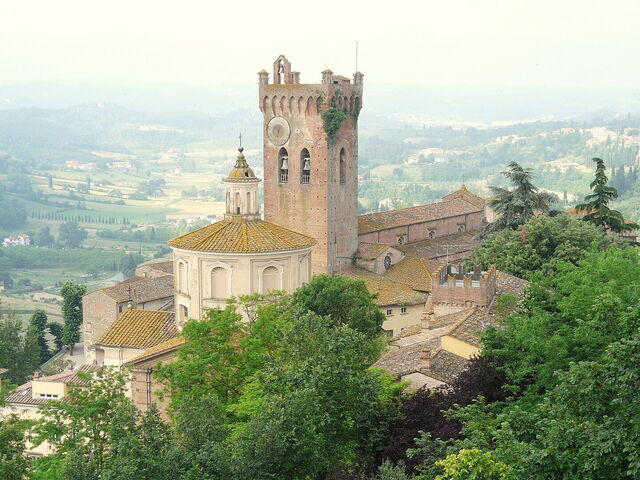
If you have been looking for a lesser-known corner of Tuscany to explore on your next getaway then we highly recommend a trip to San Miniato. San Miniato is most famous for its world-renowned truffle market each year and the surrounding area produces some of the finest white truffles in the globe. It is, therefore, a destination that some foodies may well have heard of before. However, there is more to this charming little town and plenty of other reasons to visit, though if you're a truffle fan then an autumnal getaway in the area is definitely a good idea as it is awash with delicious local products and produce to try during the harvest season. In addition to the good eating, San Miniato also boasts a charming and historic centre that has been largely untouched by time and is perfect for wandering, handmade leather goods made locally, a kite festival each Easter, wonderful panoramic views over the stunning surrounding Tuscan landscape, a small art museum that boasts famous names like Filippo Lippi, Fra Bartolomeo, and Verrocchio, and some stunning architectural gems. One such architectural gem is the town's beautiful cathedral.
The Cathedral of Santa Maria Assunta and San Genesio , or Cattedrale di Santa Maria Assunta e di San Genesio, is the mother church of the San Minianto diocese and became a cathedral in the 17th century after it was named the diocesan seat. Located in the oldest part of the city, it boasts wonderful views over the surrounding landscape from its bell tower and is one of the most important architectural gems in the city. Likely built over the foundations of an earlier church, the current cathedral traces its origins to the 12th century and is first mentioned in writing in a papal bull by Pope Celestino III in 1195. First dedicated to just Santa Maria, the church gained the additional title of San Genesio when the church of San Genesio di Vico Wallari, and the village in which it was located at the foot of San Miniato, were destroyed in 1248. The baptismal font from the destroyed church was also moved to the cathedral and there was a series of renovations that also included the addition of ceramic basins to the façade. Later in the 13th century, a bas-relief of the Annunciation by the Comacine sculptor Giroldo da Arogno was also added.
For a period, between the taking of San Miniato by the Florentines in 1369 to the stabilisation of the political turmoil in Tuscany in 1489, the cathedral was closed to the public as it was part of the city's fortress complex. Once returned to the local clergy, further alterations were made and the cathedral was expanded to include the preexisting square bell tower known as the Tower of Matilda, or Torre di Matilda. Major works on the building took place in the 1860s when it was deeply restored and then again during another grand restoration project between 2010 and 2014, after which the bell tower was opened to the public.
The façade of the cathedral is faced in red brick and decorated with 26 decorative ceramic basins (originally the were 31 in total and now all on display are copies with the originals located in the Diocesan Museum). There are three sixteenth-century sandstone portals, each surmounted by an architrave and pilasters, with the central entrance being the largest. On the level above are three rose windows (with the central one now a blind window) and on the upper part of the façade is a fourth rose window that internally overlooks the nave.
For a period, between the taking of San Miniato by the Florentines in 1369 to the stabilisation of the political turmoil in Tuscany in 1489, the cathedral was closed to the public as it was part of the city's fortress complex. Once returned to the local clergy, further alterations were made and the cathedral was expanded to include the preexisting square bell tower known as the Tower of Matilda, or Torre di Matilda. Major works on the building took place in the 1860s when it was deeply restored and then again during another grand restoration project between 2010 and 2014, after which the bell tower was opened to the public.
The façade of the cathedral is faced in red brick and decorated with 26 decorative ceramic basins (originally the were 31 in total and now all on display are copies with the originals located in the Diocesan Museum). There are three sixteenth-century sandstone portals, each surmounted by an architrave and pilasters, with the central entrance being the largest. On the level above are three rose windows (with the central one now a blind window) and on the upper part of the façade is a fourth rose window that internally overlooks the nave.
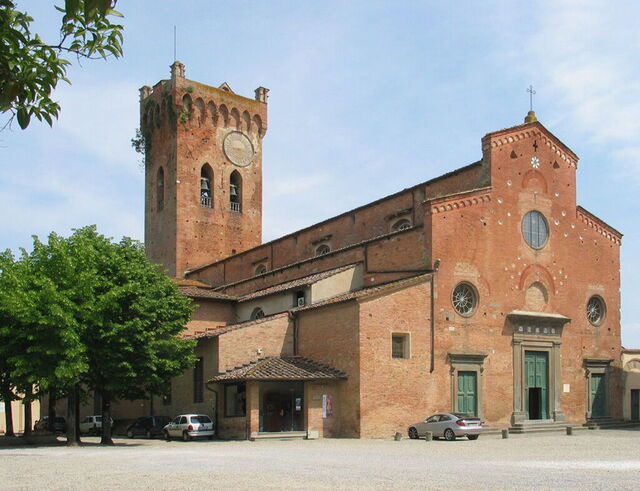
The Torre di Matilda, meanwhile, is a twelfth century square watchtower in the Romanesque style that was absorbed into the cathedral at the end of the fifteenth century, wherein it was repurposed and converted to a bell tower.
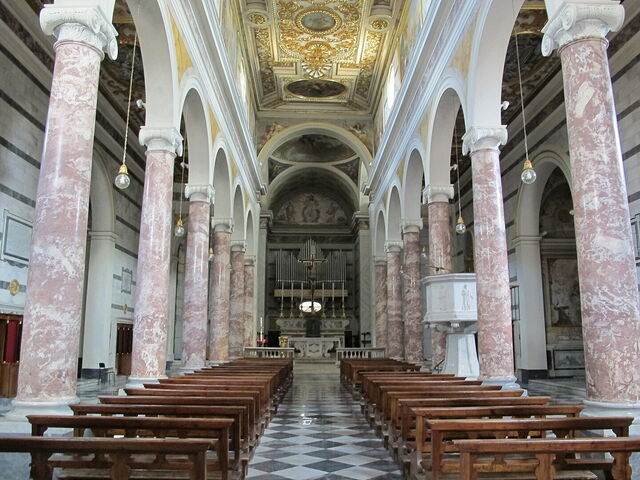
Inside, the church reflects more modern interventions and largely the work of Pietro Bernardini in the 19th century, with neo-Renaissance architectural details and Baroque decorative motifs. Built on a Latin cross plan and divided into three equal-sized naves, the interior is highly elegant and decorative with the naves separated by two series of round arches carried by Ionic columns made from polychrome imitation marble, a 17th century gilded coffered ceiling, 19th century frescoes, a marble pulpit by Amalia Dupré, funeral monuments in the aisles designed by her father Giovanni Duprè, a 17th century baptismal font by Giovan Battista Sandrini, altarpieces by the likes of Francesco d'Agnolo and Aurelio Lomi, painted canvases, a 20th century pipe organ by Francesco Michelotto, and more.
A looming and important historic, architectural, and artistic presence in San Miniato, it is an absolute must for anyone who has found a luxury villa in San Miniato and is spending an extended period of time relaxing in the area to pop into the Cathedral of Santa Maria Assunta and San Genesio at some point during your stay. It is also true that if you have found a luxury villa in Pisa and are looking for a day trip destination then a visit to San Miniato is ideal and stopping by the cathedral would factor in as one of the unmissable highlights of a one day stint in the city. A pretty gem in one of the loveliest towns in all of Tuscany, it is the kind of low-key spot that one may not be looking for but happen to stumble upon and be delighted by – unless you spotted it in this article, of course! And, if you're not too afraid of heights and are able for a climb, it is definitely a must to pay to head up the bell tower for one of the most stunning views in all of Tuscany!
Inside, the church reflects more modern interventions and largely the work of Pietro Bernardini in the 19th century, with neo-Renaissance architectural details and Baroque decorative motifs. Built on a Latin cross plan and divided into three equal-sized naves, the interior is highly elegant and decorative with the naves separated by two series of round arches carried by Ionic columns made from polychrome imitation marble, a 17th century gilded coffered ceiling, 19th century frescoes, a marble pulpit by Amalia Dupré, funeral monuments in the aisles designed by her father Giovanni Duprè, a 17th century baptismal font by Giovan Battista Sandrini, altarpieces by the likes of Francesco d'Agnolo and Aurelio Lomi, painted canvases, a 20th century pipe organ by Francesco Michelotto, and more.
A looming and important historic, architectural, and artistic presence in San Miniato, it is an absolute must for anyone who has found a luxury villa in San Miniato and is spending an extended period of time relaxing in the area to pop into the Cathedral of Santa Maria Assunta and San Genesio at some point during your stay. It is also true that if you have found a luxury villa in Pisa and are looking for a day trip destination then a visit to San Miniato is ideal and stopping by the cathedral would factor in as one of the unmissable highlights of a one day stint in the city. A pretty gem in one of the loveliest towns in all of Tuscany, it is the kind of low-key spot that one may not be looking for but happen to stumble upon and be delighted by – unless you spotted it in this article, of course! And, if you're not too afraid of heights and are able for a climb, it is definitely a must to pay to head up the bell tower for one of the most stunning views in all of Tuscany!
Photo credits:
Picture 1: Davide Papalini / CC BY-SA 3.0;
Picture 2: Sailko / CC BY-SA 3.0;
Picture 3: Manfred Heyde / CC BY-SA 3.0
Picture 1: Davide Papalini / CC BY-SA 3.0;
Picture 2: Sailko / CC BY-SA 3.0;
Picture 3: Manfred Heyde / CC BY-SA 3.0