Extending over 306 hectares across two sites – at Montalcino and Scansano – the winery of Fattoria dei Barbi goes back centuries and helps preserve the rich history and heritage of wine in the area. Having won prizes for their Brunello all over Europe since the late nineteenth century and continuing to do so to this day (but now all over the globe), this is the ideal spot for those interested in Tuscan wine and the Brunello variety, in particular. Just find your perfect getaway spot by browsing our luxury villas in Montalcino and then set aside some time to visit the winery for yourself and learn more about their business, history, and production while also getting to taste some exceptional wines in Tuscany.
Florence is one of those cities that, somehow, keeps surprising and delighting us all the time with new finds. Whether it is long-forgotten historic gems or new openings, there is always something new to uncover every time you find a luxury villa in Florence, which is why it is a perfect destination for both first time visitors and repeat offenders alike. One new discovery in our office that tickled everyone’s fancy has to be the buchette del vino, which were once-ubiquitous wine windows through which one could, for a long time, pass a few coins and receive a flask of wine in return. Most are now long gone and have been out of use for even longer but there is one that has been recently reopened. If you’re planning on spending time in Florence and want to try out this unique and historic resurrected foodie experience, then head to the neighbourhood of Santo Spirito and see for yourself!
Santo Spirito is where you will find a new restaurant called Babae that opened back in August and, along with its culinary offerings indoors, brought back with it one of Florence’s buchette del vino and the Florentine tradition of buying wine through a window. These date back to the Renaissance, when many noble families of the city, who lived in the grand palazzos that still characterise the centre of Florence, had their own vineyards either just outside the city walls or off in the Tuscan countryside.
Santo Spirito is where you will find a new restaurant called Babae that opened back in August and, along with its culinary offerings indoors, brought back with it one of Florence’s buchette del vino and the Florentine tradition of buying wine through a window. These date back to the Renaissance, when many noble families of the city, who lived in the grand palazzos that still characterise the centre of Florence, had their own vineyards either just outside the city walls or off in the Tuscan countryside.
If you are looking for a winery that is synonymous with quality and timeless Chianti Classicos, then you need look no further than Castello di Monsanto. A must-see for wine-lovers that have found a vacation rental in Barberino Val D'Elsa, Castello di Monsanto is an elegant winery full of character that is set within the grounds of a castle and estate that dates back to the middle of the 18th century.
The story of wine at Castello di Monsanto is a little more recent and goes back to 1960 when Aldo Bianchi, a native of San Gimignano, came back to the area in which he was born and raised for a wedding at the castle. He became so enamoured by the view from the terrace of the castle – across the Val d’Elsa and right over to the famous towers of San Gimignano – that he fell madly in love with the place and had purchased it within a few months. Later, when Aldo passed on the castle to his son Fabrizio and his wife Giuliana, the couple planted new vineyards and restructured the surrounding hamlets. The first cru of Chianti Classico was then born in 1962. As of 1996, the estate and the production of wine has been passed down to the third generation of the family, Fabrizio and Giuliana’s daughter, Laura and since 2001, they have all worked in collaboration with the wine maker Andrea Ginovannini in order to continue on with the ever-innovative and experimental spirit of the brand.
The story of wine at Castello di Monsanto is a little more recent and goes back to 1960 when Aldo Bianchi, a native of San Gimignano, came back to the area in which he was born and raised for a wedding at the castle. He became so enamoured by the view from the terrace of the castle – across the Val d’Elsa and right over to the famous towers of San Gimignano – that he fell madly in love with the place and had purchased it within a few months. Later, when Aldo passed on the castle to his son Fabrizio and his wife Giuliana, the couple planted new vineyards and restructured the surrounding hamlets. The first cru of Chianti Classico was then born in 1962. As of 1996, the estate and the production of wine has been passed down to the third generation of the family, Fabrizio and Giuliana’s daughter, Laura and since 2001, they have all worked in collaboration with the wine maker Andrea Ginovannini in order to continue on with the ever-innovative and experimental spirit of the brand.
28
Aug
2019
2019
It makes sense that so many wineries today are located on the grounds of castles and noble estates as these are often home to long-standing vineyards and wine production facilities that are centuries-old. Even if these estates have long since passed from the hands of a noble family, the tradition of wine being made in such places continues on into the modern era. One such estate is that of the Castello della Paneretta, which is located right smack in the globally famous Tuscan wine-producing region that is the Chianti Classico area, on the western slopes of the hills overlooking the Val d'Elsa, facing towards San Gimignano. If you have found a vacation rental in Chianti and you are looking for a traditional winery experience, then this is a really great choice!
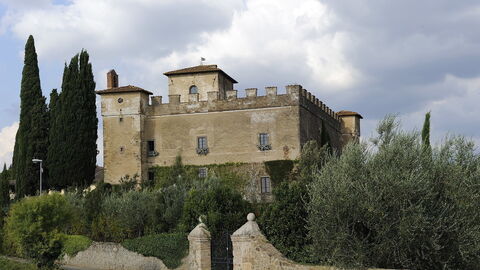
Wine production at Castello della Paneretta is recorded as far back as 1596 when the first harvest is described in farm documents that can be found in the Riccardiana Library. This makes Castello della Paneretta one of the oldest companies in the Chianti Classico area and, certainly, one of the most long-standing producers of wine in Tuscany. The castle itself was built on the site of an ancient watch tower, the Cepparello fortress, which was located a little lower down the slope and was abandoned and destroyed after the Battle of Montaperti in 1260. Built in the 14th century, the Castello della Paneretta is a striking medieval stronghold that is characterised by massive walls, a Guelph battlement, and corner towers, all framing a keep at the centre.
Wine production at Castello della Paneretta is recorded as far back as 1596 when the first harvest is described in farm documents that can be found in the Riccardiana Library. This makes Castello della Paneretta one of the oldest companies in the Chianti Classico area and, certainly, one of the most long-standing producers of wine in Tuscany. The castle itself was built on the site of an ancient watch tower, the Cepparello fortress, which was located a little lower down the slope and was abandoned and destroyed after the Battle of Montaperti in 1260. Built in the 14th century, the Castello della Paneretta is a striking medieval stronghold that is characterised by massive walls, a Guelph battlement, and corner towers, all framing a keep at the centre.
Located not far from the town of Castiglione della Pescaia, in the heart of the Maremma, there is a particularly beautiful winery called Le Mortelle. Vineyards and wineries are dotted all over the area but this particular example is especially charming and set within the most extraordinary surroundings. It is an excellent spot to go and sample and purchase some delicious Tuscan wines and learn more about wine and wine-making so, if you have found a vacation rental in the Grosetto-Maremma area and are looking to indulge in some local vintages, make sure to head to Le Mortelle.
Named after the “mortella”, or wild myrtle, that grows all over the surrounding landscape of the area, the winery is on an estate that was once part of an even larger estate called La Badiola that is recorded on the maps of Grand Duke Leopoldo II of Tuscany in the 19th century. La Badiola was a pilot version of a model of an estate that the Hapsburg Lorraine rulers of the Grand Duchy hoped to establish, in which the marshy and malaria-ridden lands of this coastal part of Tuscany would be drained and repurposed for raising cattle. This land, however, has been since reappropriated once more and the 270 hectares of the estate have been planted with 170 hectares of vineyards of Cabernet Sauvignon and Cabernet Franc, as well as more recently planted vineyards of white grape varieties such as Vermentino, Ansonica, Viognier, and a small area of Carménère by the Antinori family.
Named after the “mortella”, or wild myrtle, that grows all over the surrounding landscape of the area, the winery is on an estate that was once part of an even larger estate called La Badiola that is recorded on the maps of Grand Duke Leopoldo II of Tuscany in the 19th century. La Badiola was a pilot version of a model of an estate that the Hapsburg Lorraine rulers of the Grand Duchy hoped to establish, in which the marshy and malaria-ridden lands of this coastal part of Tuscany would be drained and repurposed for raising cattle. This land, however, has been since reappropriated once more and the 270 hectares of the estate have been planted with 170 hectares of vineyards of Cabernet Sauvignon and Cabernet Franc, as well as more recently planted vineyards of white grape varieties such as Vermentino, Ansonica, Viognier, and a small area of Carménère by the Antinori family.