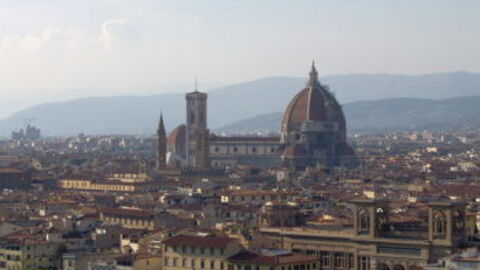
Palazzo Pitti

Palazzo Pitti

Posted in: Florence Localities Museums & Galleries Tourist Attractions
In Florence, it can be difficult to not accidentally bump into some grand piece of history. The city is nothing if not living, breathing history: a museum that people live their day to day lives in. One such piece of history lies right across the Arno from the Palazzo Vecchio and the Uffizi Gallery, the Palazzo Pitti.

The Palazzo Pitti was originally constructed by Luca Pitti who gained his wealth as a banker in Florence.
Duomo di Siena
Posted in: Churches & Religious Buildings Localities Siena Tourist Attractions
According to legend, Siena was founded by the sons of the fabled founders of Rome, Romulus and Remus. One rode a black horse and the other a white horse, giving the city its symbolic colors that continue today in the symbol of the commune on its coat of arms. The city's colors and legends also live on in one of the most memorable sites the city has to offer: the Duomo di Siena. The Duomo di Siena was built with striped white and black marble, echoing the city's colors all the way up to the bell tower.

The impressive cathedral was built in many different spurts of construction, with additions after the departure of a former architect or artisan, as well as, when the church simply needed an expansion. One massive expansion was planned in the fourteenth century that would have doubled the size of the church as it is today, but unfortunately was not completed as the Black Death had finally visited fair Siena.
Piazza del Campo
Posted in: August Events July Localities Siena
The tradition of the Palio dates back to medieval times, when most of the communities throughout Italy would have a local athletic competition between the contrades, or districts, of the town. Less populated areas would have the hamlets of a commune compete against one another. The traditions were typically a commemoration of an event that varied from town to town, some had jousts, archery tournaments, horse races, and even bull fights right in the city. Other cities have changed the traditions to slightly safer contests, much like Montepulciano's Bravio delle Botti.
Lucca City Walls
Posted in: Localities Lucca
Most, if not all, of Tuscany's cities, towns and villages have roots well beyond the medieval age. Many have been able to retain their historic centers within the ancient city walls.
These walls, which protected the city and its residents for centuries, still protect the city to this day: acting as a barrier to keep urbanization and modernization out of their historic town centers.

Lucca is a prime example of this; its city walls keep out the modern world and allow for a deeper immersion into the culture and history of the city for visitors and residents alike. Imagine how much more you might appreciate parts of your home town if you had to walk through them each day and you had the time to see the little things we rocket past in our normal, day-to-day, rushing lifestyle. But Lucca has taken their city walls to a step beyond that of most...
Posted in: Florence Localities Museums & Galleries Tourist Attractions
When thinking of Florence, one name repeatedly comes to mind: Medici. The Medici’s were arguably the most powerful family in Tuscany, in Italy from the thirteenth to the seventh centuries.

The Medici’s expanded the territory of the Grand Duchy of Tuscany during their rule through military might, political influence, and simple timing as many smaller towns were ravaged by the Plague and suddenly found the advances of Florence more affable in their weakened state. The Medici’s many contributions to the city are still standing as a testament to their rule. One of the most notable of these landmarks is the Palazzo degli Uffizi, sitting serenely off of the Piazza della Signoria across from the Palazzo Vecchio.

Construction on the Uffizi began in 1560 by the Grand Duke of Tuscany, Cosimo I de’Medici. His trusted architect Giorgio Vasari designed and oversaw the construction of the Palazzo degli Uffizi. The original intent of the Palazzo was to house the offices of the city magistrates, but slowly the halls and the rooms of the Uffizi were transformed to house the ever growing collection of art that the Medici’s procured.