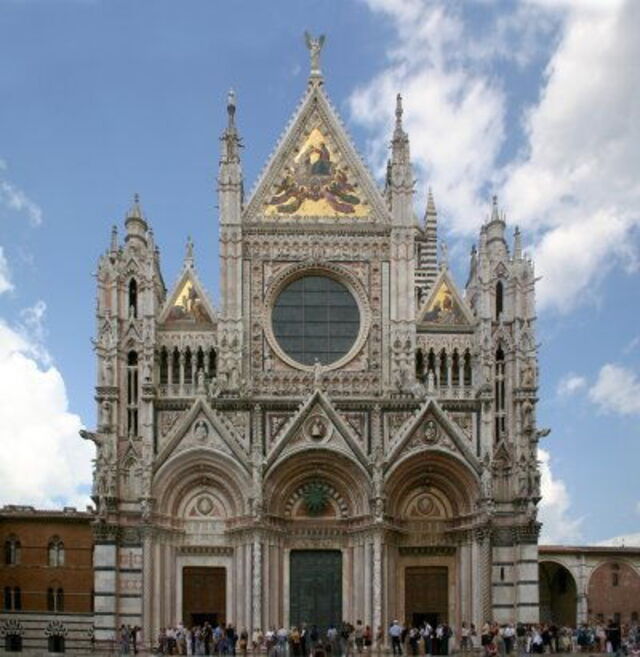
According to legend, Siena was founded by the sons of the fabled founders of Rome, Romulus and Remus. One rode a black horse and the other a white horse, giving the city its symbolic colors that continue today in the symbol of the commune on its coat of arms. The city's colors and legends also live on in one of the most memorable sites the city has to offer: the Duomo di Siena. The Duomo di Siena was built with striped white and black marble, echoing the city's colors all the way up to the bell tower.
The impressive cathedral was built in many different spurts of construction, with additions after the departure of a former architect or artisan, as well as, when the church simply needed an expansion. One massive expansion was planned in the fourteenth century that would have doubled the size of the church as it is today, but unfortunately was not completed as the Black Death had finally visited fair Siena.
The impressive cathedral was built in many different spurts of construction, with additions after the departure of a former architect or artisan, as well as, when the church simply needed an expansion. One massive expansion was planned in the fourteenth century that would have doubled the size of the church as it is today, but unfortunately was not completed as the Black Death had finally visited fair Siena.
Though after construction had began on the expansion it was evident that there were flaws in the plan, they are still there today as an attached museum.
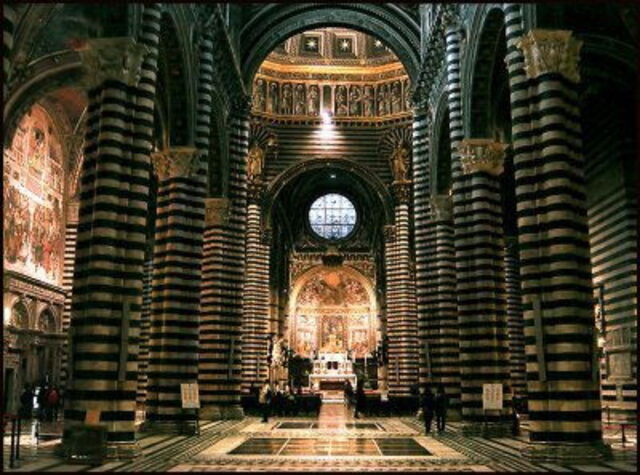
Inside the Duomo di Siena the black and white striped theme is continued, and it is one of the most beautiful churches you will ever lay eyes on. All around the cathedral you will see sculptures and carvings: along the nave is a series of busts of 172 popes beginning with Saint Peter and ending in the 16th century, the columns are topped with various beasts, another series of busts display 36 Emperors. Massive groupings of columns split the aisle, with the stripes seeming to draw your eyes upwards to the impressive dome.
Inside the Duomo di Siena the black and white striped theme is continued, and it is one of the most beautiful churches you will ever lay eyes on. All around the cathedral you will see sculptures and carvings: along the nave is a series of busts of 172 popes beginning with Saint Peter and ending in the 16th century, the columns are topped with various beasts, another series of busts display 36 Emperors. Massive groupings of columns split the aisle, with the stripes seeming to draw your eyes upwards to the impressive dome.
Even the floor is a masterwork of mosaics, a series of over 56 panels of differing sizes depicting various scenes and stories. The entire floor of the cathedral is covered in these mosaics, and undertaking that took roughly 200 years and over 40 different artists contributing their works. The mosaics are intact and in their original states, and as such as covered much of the year. Some are left uncovered to display to the public but throughout the year the entire floor is uncovered and available for viewing, this year from August 16th through October 27th.
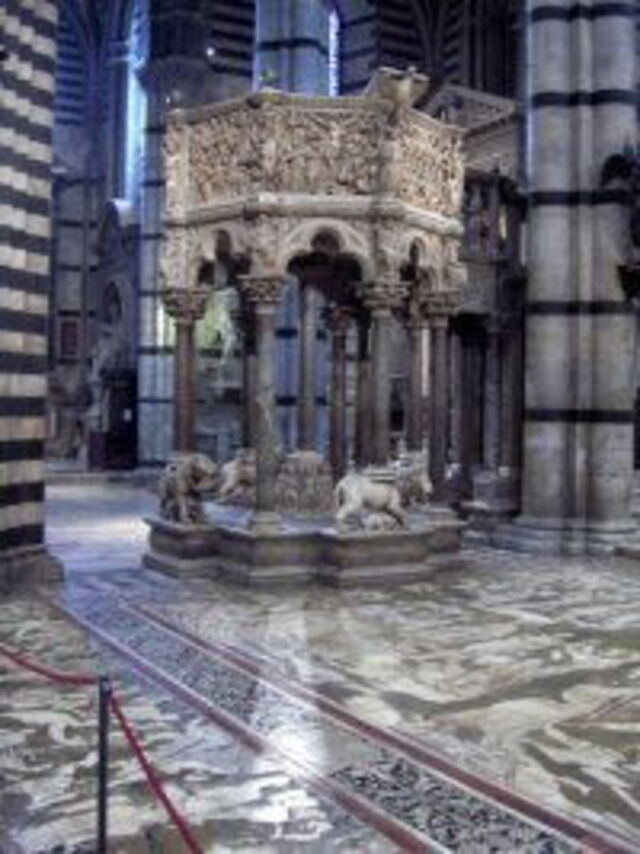
The pulpit in the Duomo di Siena is an astounding raised pulpit that was created by famed sculptor Nicola Pisano; he was commissioned in Siena after his work in Pisa on a similar pulpit had brought him accolades from across Tuscany. This work is considered my many to be his masterpiece and brought attention to his son as well, who helped extensively through it's creation. Having been completed in 1268, this remains as the oldest work in the cathedral.
Whether you are staying in Siena during your vacation to Tuscany, or haven't yet planned out your stay: be sure to make a stop in Siena to see this masterpiece of Gothic architecture and art.
Whether you are staying in Siena during your vacation to Tuscany, or haven't yet planned out your stay: be sure to make a stop in Siena to see this masterpiece of Gothic architecture and art.